
DON'T buy life insurance unless it does these FOUR things!
From the office of
Richelle Dickerson
Financial Strategist/CEO/Licensed Broker/Certified Financial Planner

I've had the same conversation at least 200 times in my career.
Someone calls my office. Usually in their 50s or 60s. Their term life insurance is coming up for renewal.
The premium they've been paying—$80 a month—is about to jump to $400 or $600 a month.
They can't afford it. They ask if they can get a new policy instead.
That's when I ask about their health. High blood pressure? Diabetes? Heart issues?
And that's when I realize: they can't get a new policy.
Or if they can, it'll cost even more than the renewal.
So they're faced with an impossible choice:
Pay premiums they can't afford, or cancel a policy they've been paying into for 20 years—and lose all coverage right when their family needs it most.
Here's what didn't get explained twenty years ago:
Term insurance is affordable during working years.
But it's not designed to be permanent.
At the end of the term, premiums can jump 400-700%.
By that age, health issues make new coverage impossible or prohibitively expensive.
The question nobody asked them:
"What coverage will you need for the rest of your life, regardless of when you pass away?"
Funeral costs, debts, estate settlement—these don't go away.
Your family will face these expenses whether you die at 45, 65, or 95.
That coverage needs to be permanent.
Mortgage protection, income replacement, education funding—those are temporary needs. Term insurance handles those.
But mixing up which coverage should be temporary and which should be permanent?
That's where families get trapped decades later.
I created the DIME framework to solve this exact problem:
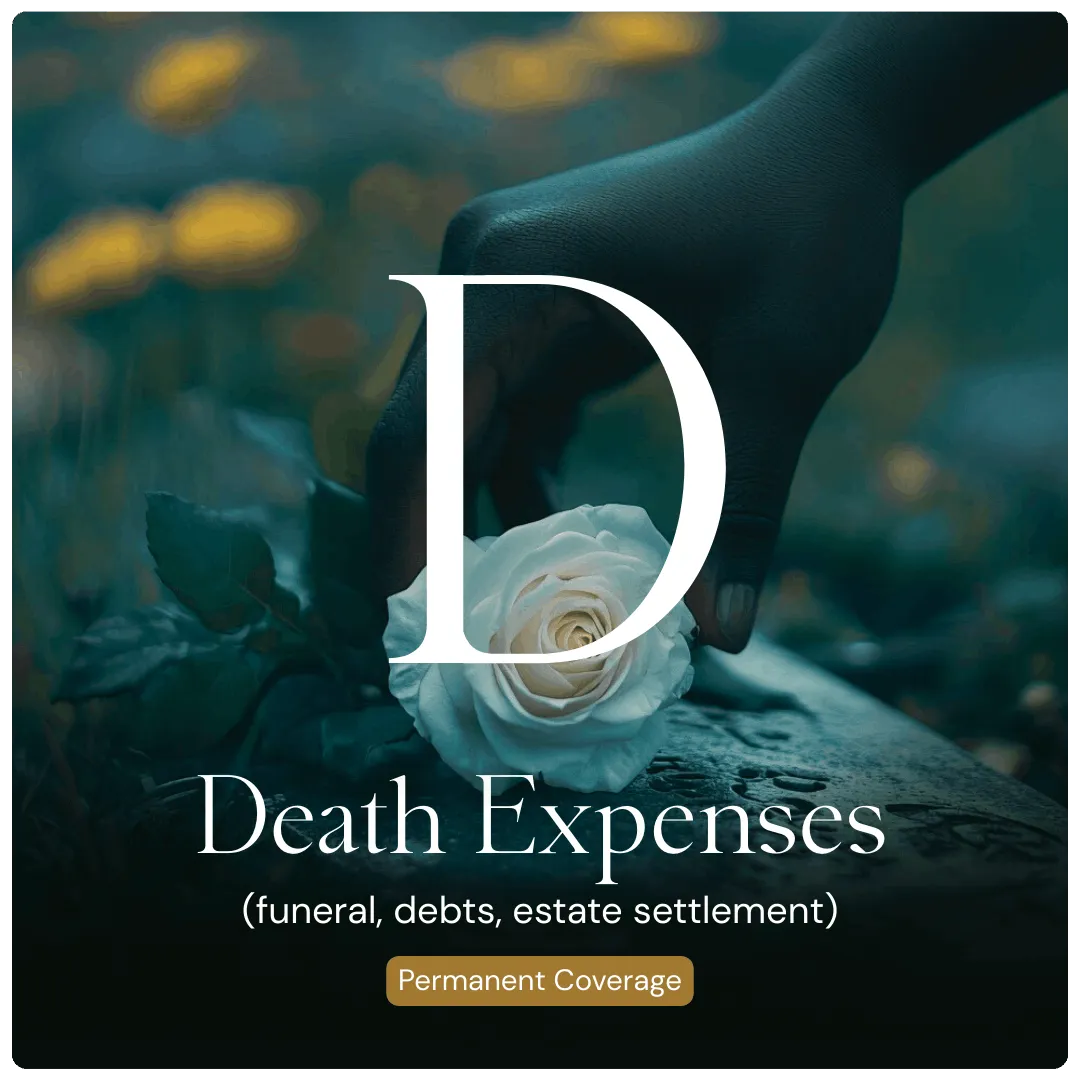
D – Death Expenses (funeral, debts, estate settlement) → Permanent coverage

I – Income Replacement during working years → Term coverage

M – Mortgage Balance → Term coverage

E – Education Funding for children → Term coverage
When you answer these FOUR questions, you can see which needs are temporary and which are permanent.
Then you structure your policies accordingly.
Most families use a combination: permanent coverage for guaranteed final expenses (often as affordable as $50-80/month for $50,000-$100,000 in coverage), plus term coverage for temporary needs.
Here's what I'll do for you...
Your family gets taken care of—without the burden falling on them.
When you structure your coverage correctly:
Your funeral and final expenses are covered—no one has to scramble for money or go into debt
Your mortgage gets paid off—your family keeps the home
Your income gets replaced during the years they need it most—bills get paid, kids stay in school
Your education fund is there when your kids are ready for college
Your permanent coverage never expires and the premium never increases.
It's locked in. Forever.
No phone call at age 65 where the premium jumps to an amount you can't afford.
No losing coverage right when your family is most likely to need it.
Your family is protected. Period.
The right coverage means when you're gone, your family can grieve—not scramble to pay bills or figure out how to cover a funeral.
Here's what I want you to do next
Book a complimentary 30-minute DIME Assessment.
I'll walk through your specific situation:
Review any current coverage you have
Calculate your actual coverage needs using DIME
Show you what permanent vs. term coverage would cost
Answer your questions about structuring your policies
No obligation to purchase. Just clarity.
I have this conversation too often with people who wish they'd understood this twenty years ago.
You don't have to be one of them.
— Richelle Dickerson, CFP®
A Simple Conversation. Clear Answers.
This is a confidential, one-on-one conversation to review your situation, answer your questions, and determine whether there’s a clear path to help you secure what you’re entitled to. No pressure. Just clarity.
Copyright © 2026 Rhema Financial Solutions Inc - All Rights Reserved.